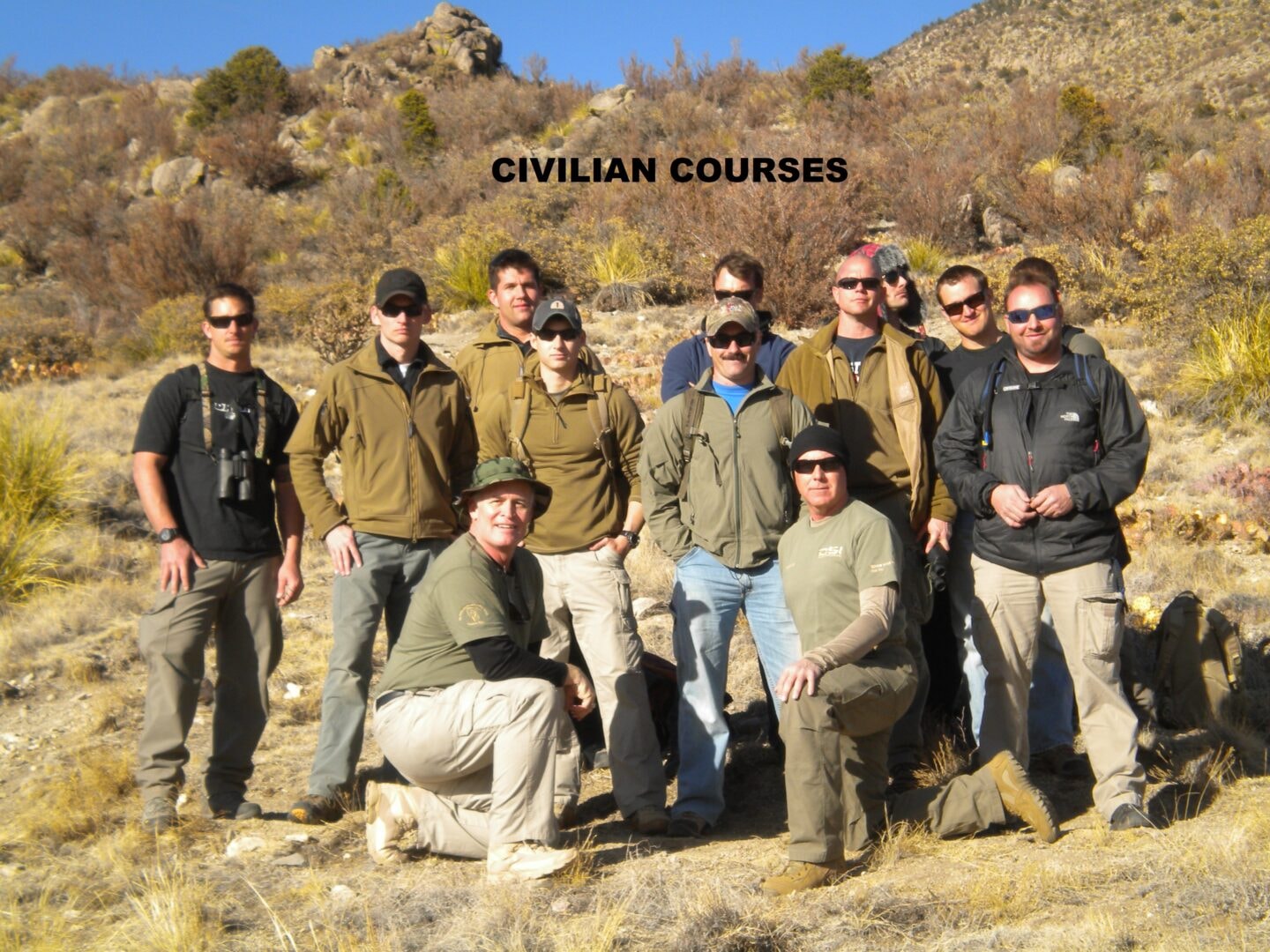
Dynamic Strategies International empowers civilians with the knowledge and skills to handle real-world threats and emergencies. From wilderness survival to personal security awareness, our civilian programs are taught by the same expert instructors who train military and law enforcement professionals.
Search and Rescue Training Program
Incidents such as missing persons, lost individuals, natural disaster etc. commonly need search and rescue professionals and volunteers for assistance in recovery efforts. ThreatEvents.com has developed a Search and Rescue training program specifically designed for citizens who could be called upon to augment search and rescue efforts. Our Search and Rescue Training takes a comprehensive approach by offering tiered training programs in K9 Search and Rescue, Search & Rescue, Tracking, and Skill Management. The program consists of structured classes of varying levels from basic foundation training to advanced skills. This not only teaches the students skills needed to properly search for missing persons, but it gives citizens and agencies an opportunity to coordinate each other's roles during a search & rescue incident.
We use subject matter experts (SME) from the field of tracking to teach the students to identify the difference between a natural ground environment verses an unnatural one. This skill will give the student the ability to identify and analyze any ground disturbance in their surroundings and use this information for assessing indicators to identify lost or missing persons. By analyzing disturbances, the skill set can assist in confirming and denying positive links to the missing person. This skill set also provides for an ability to interpret subtle disturbances and indicators that will aid the student in determining and reconstructing the sequence of events at any location without prior knowledge or observation of the actions taking place. It will make the student more aware of incident scene surroundings and enhance the ability to detect subtle evidence and clues left behind.
Our program demonstrates and teaches the basic techniques for measuring activity by teaching the elements of the human pace. Our program includes considerable time in the spoor pit demonstrating different activity indicators and methods to interpret those indicators. The students will become proficient in their ability to approach disturbances on the ground and through analyzing and interpretation of that disturbance, be able to accurately assess the actions that took place such as direction of travel, movement types, goals, mental state, injuries, tactics, awareness, equipment, weapons, intent etc. of the query. Students will be taught that direction of travel can also be interpreted through the use of pointers (compressed grass and broken sticks), transference, and primary impact points.
The program includes instruction on different team formations and methods of movement and how they are critical to the terrain and environment the team is operating in. For example, the students will understand that, in order to remain vigilant, being able to observe ground disturbance in all environments is essential. The students are taught that moving through a close country or tropical environment verses movement through open desert type environments require distinctly different formations, procedures and team communications. The program will also familiarize the student with techniques for aging sign/spoor and the effects that the terrain and environment has on that process.
During our program the student will learn Micro Tracking techniques and the role it plays in search and rescue. This technique and the indicators are also important for operating in new or unfamiliar terrain and assists trackers in adjusting to a sudden change in the track line or environment.
In order for a tracking team to be effective, it is paramount that students be knowledgeable of lost spoor drills. Our program teaches a variety of lost spoor drills for both close country and open country environments.
Backtracking techniques have their own unique formation and procedure requirements and are generally non-tactical in nature.
The program also includes technical field craft skills and training in additional topics such as Skill management, outdoor survival, self sufficiency, outdoor environmental hazards, outdoor clothing, personal equipment, land navigation, night time operations, and negotiating hazardous terrain.
Rural Survival Course
ThreatEvents.com offers several courses to meet the needs of civilians in today's uncertain times. These courses offer skill sets that carry over into every aspects of life including family protection, situational awareness, self-awareness, team building, boost of confidence, increased self-esteem and most importantly, survivability.
Our most popular course is the 2-day Rural Bush Craft program. This program is a basic survival course designed to be enjoyed by individuals seeking to learn to enhance survivability in rural settings while using limited resources. The course includes teaching the student basic survival skills and priorities such as finding food, shelter, fire and water. The course also includes teaching a basic understanding of terrain association land navigation. This course is conducted in the outdoors and includes an overnight duration in a secluded rural setting. Upon completion, the student will possess the basic skills and knowledge required to sustain life in multiple types of austere rural environments.
Our 5 day Bush Survival Tracking program includes the two day Bush Craft course plus an additional three day program that includes advanced survival skills and basic tracking techniques. Students will learn advanced techniques to enhance survivability in austere rural environments including snare/traps, water collection, purification and preservation, advanced fire starting skills, nighttime navigation, primitive weapon acquisition, and advanced shelter construction.
Our 7 day Adventure Course is a program designed for the student seeking a physical challenge that will result in a strong sense of accomplishment and confidence. The Adventure Course includes the 5 day Bush Tracking Survival Course plus an additional two days of movement and hiking over rough terrain and distance. It includes teaching the student Proper River and Obstacle crossing techniques and climbing techniques. Even though this course is enjoyable, it is physically and mentally challenging and requires the student to be in good physical condition.
Urban Survival Course
ThreatEvents.com offers a 2-day Situational Awareness program and a 5-day Urban Survival Program dedicated to city survival. These programs are designed for almost any age, gender and physical condition who desire to increase awareness and perspective on things and events taking place around them in urban environments. Both of these courses are ideal for individuals wishing to increase awareness of the everyday work/home environment or preparing for a major catastrophic event. Once completing the course, all students will leave with a sense of achievement, self confidence, reliance and awareness. These courses are intended for those who wish to be properly prepared for catastrophic events in urban settings such as major hurricanes, earthquakes, manmade or natural disasters or the breakdown and deterioration of society. The skill set can also be used to enhance and increase effectiveness in the decision making process of everyday activities. These programs increase a person's ability to not only survive but to thrive in any environment that might otherwise prove to be life threatening.
The 2-day course centers on teaching body language, observation techniques and the proven skill set of human behavior and predictive analysis. These skill sets help students recognize and understand the natural flow of an environment and the way people move within it. Understanding this "natural flow" gives the student the ability to detect potential threats in any environment and the knowledge to take proper actions to mitigate those threats. Human threat indicators are traits based on common patterns that people display when preparing for a threat event or hostile act. These traits can be recognized from a distance, are universal and applicable to the general populace of any culture. ThreatEvents.com will teach the student key methods to substantially increase their ability to not only observe, recognize and identify threats and dangerous situations but proper reactions to counter those threats. The program includes an exercise where students will have the opportunity to test their new skills by locating anomalies and threats in both staged and real time environments.
The 5-day Urban Survival Program includes the 2-day Situational Awareness program plus an additional 3 days of urban survival techniques. It also includes techniques to enhance security and family oriented safety, communications, movement, and basic survival elements such as seeking food, shelter, fire and water in urban settings that are experiencing deteriorating events. It also covers planning and preparation for such events.
Security for Worship Organizations
Because churches and religious gatherings are vulnerable to acts of targeted and random violence, they must have proper security measures in place, not only protect the safety of the people and property, but also promote the freedom to worship without concern. While there is no one solution to issues concerning church security, many current security training programs center primarily on reactive measures verses a safer proactive solution. Security for Worship Organizations & Routine Development is a training program that focuses on proactive methods of predictive assessment of the worship environment that will dramatically enhance and improve the student's Awareness and Threat Detection (ATD) capabilities. These capabilities will give the student the upper edge for detecting and deterring threats in congregations such as active shooters, violent disruptions, attacks, bomb incidents, emotional confrontations etc. the training teaches methods to accurately assess the congregation premises and the worship environment and gives the student the ability to predict the potential for a threatening event to escalate.
The program is designed to directly enhance the student's capabilities in advanced threat awareness skills and allows for a proactive approach to observe and identify the threat indicators that exist within human dynamics and the physical environment. The program teaches students how to establish baselines in their environment and how to recognize certain anomalies that indicate potential threats through analysis of human behavior, body language and environmental awareness.
Reading Danger for Real Estate Agents
Compared to other professions, Real Estate is considered by security experts and law enforcement to be a high-risk profession. According to recent Bureau of labor studies, the real estate industry experiences about a 40% higher rate of on-the-job crime than the average profession. Real Estate Agent attacks can be motivated by a variety of incidents such as theft of money and jewelry or can be a sexual predator preying on a target of opportunity. The Real Estate Agent has seen an average of more than 75 homicides a year beginning in 2003 and according to the Bureau of Labor and Statistics, the numbers continue to rise. Most of the deaths and violent acts were identified as personal attacks that took place while the agent was at work or alone with a potential client.
Randy has recognized the need to mitigate the growing trend of the criminal violence, robberies and assaults directed towards Realtors and has developed a proactive training program to counter these trends. These learned skill sets will dramatically enhance and improve the Real Estate Agents awareness and Threat Detection (ATD) capabilities. The program is designed to directly enhance the Real Estate Agent's capabilities in threat awareness skills and allows a proactive approach to observe and identify threats through indicators that exist in the human and terrain environment. The program teaches students how to establish baselines in their work environment and how to recognize certain anomalies that indicate potential threats through human behavior, body language and environmental awareness.
The training teaches methods to accurately assess public contacts and gives the agent the ability to predict the potential for an encounter or public contact to escalate into a threatening event.
Hostile Environment Awareness Training
In a recent survey of 256 firefighters and emergency medical workers from throughout the U.S., more than 48 percent said that they had been physically assaulted at least once while on duty. Experts estimate that there are 700,000 assaults on paramedics and EMTs every year, and the National fallen Firefighters Foundation lists assaults as one of the top 16 safety issues that firefighters face when responding to calls.
On a daily basis, first responders will risk their lives to save innocent civilians while exposing themselves to the dangers of evil men who seek to do them harm. Unfortunately, many responders have been injured or killed while responding to assist those in need at the hands of angry shooters, terrorists, explosive devices, emotionally distraught, mentally disturbed and many other facets of danger. In light of the recent events surrounding violent attacks and assaults directed towards First Responders, PATC is prepared to offer a proactive training program designed to mitigate assaults and help reduce the risk of injury and death of responding personnel. The Hostile Environment Awareness Training (HEAT) program was developed and designed specifically for all men and women who earn a living by rushing into hazardous situations to help those in need.
The HEAT program relies on a proactive approach that teaches skill sets to dramatically enhance and improve the responders Awareness and Threat Detection (ATD) capabilities. The training can help 1st responders detect and thwart planned assaults and gives the student the ability to recognize the potential for any situation to turn hostile. This will give them the opportunity to respond, mitigate and deescalate the event before it can turn into a life-threatening situation. It benefits EMTs/Paramedics, firefighters, security personnel, police officers and also helps protect all from ambush-type situations. The training teaches 1st responders methods to accurately assess bystanders and the environment and gives them the ability to predict the potential for an encounter to escalate into a threatening situation.
The program is designed to directly enhance 1st responder personnel capabilities in advanced threat awareness skills and also allows an aggressive approach to observe and identify booby traps, IEDs, ambushes and other threats in a multitude of environments through threat indicators. The program teaches responders how to establish baselines in their environment and how to recognize certain anomalies that indicate potential threats using human behavior analysis, body language and environmental awareness.