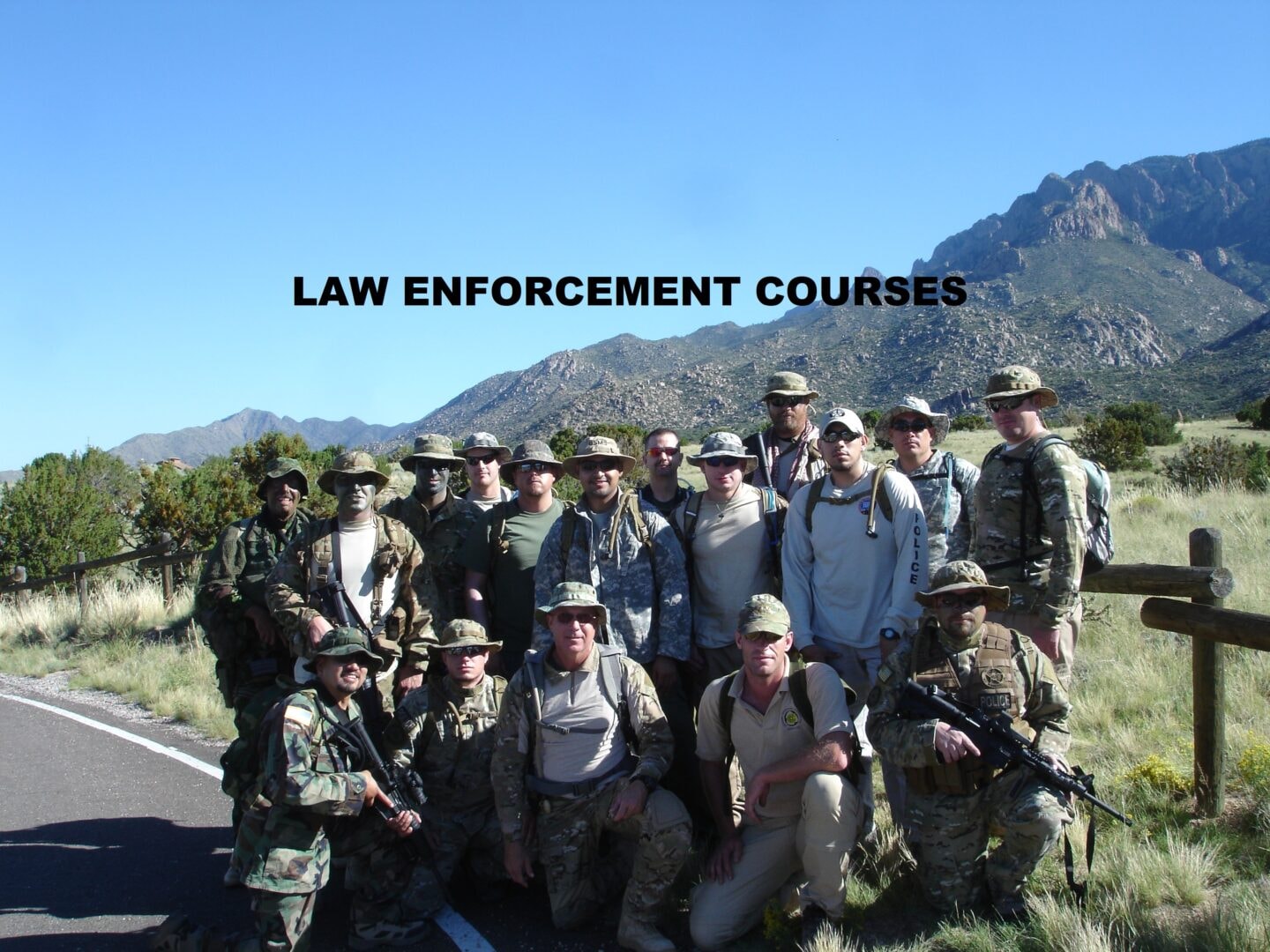
Dynamic Strategies International provides law enforcement agencies with cutting-edge training programs that enhance officer safety, investigative capability, and tactical proficiency. Our curriculum is built on proven field techniques and real-world operational experience.
Ambush & Lethal Environment Recognition (ALERT) Training
While ambushes are a leading cause of officer fatalities in firearms related deaths, current law enforcement training does not typically focus on instruction to mitigate ambush encounters. ThreatEvents.com has developed a training program focused on detecting and deterring threats toward law enforcement officers and local, state and federal law enforcement agencies. The Ambush & Lethal Environment Recognition Training (ALERT) program is a proven method of proactively identifying threats and events through predictive analysis of human behavior patterns, terrain awareness and enhanced observation techniques. ALERT is a skill set that allows officers the improved ability to make accurate analysis of threatening events before they escalate by being able to predict common actions based on observed human behaviors within the environment. The ALERT course ensures that officers receive the necessary training and communication skills to diffuse those potential threats into nonthreatening events. This training will give the participating officer an ability to recognize, assess and mitigate risks before they take place.
ThreatEvents.com delivers Subject Matter Expertise, classroom instruction, field exercise programs, instruction material training, certification, and assessment of training in a skill set that dramatically enhances and improves the law enforcement officer's Awareness and Threat Detection (ATD) capabilities. The training is offered in a 3 Bay Basic Level or a 5 Day Advanced Level program. The 5 Day Advanced Level program includes the Basic Level plus additional hours of training filled with hands on practical exercises in an array of scenarios that place the student in real life training environments. The students will be exposed to scenarios that required them to perform in both rural and urban environments during the daylight, lowlight and late-night demonstrations. The training includes a complex Field Training Exercise (FTX) and scenarios requiring the student to apply all learned skills in environments shaped to simulate their current job assignment. Over 70% of the training will be dedicated to realistic field exercises as opposed to classroom.
Former students overwhelmingly agree that our awareness programs should be a requirement for all Law Enforcement officers.
Courtroom Security
Because courthouses are vulnerable to acts of random violence, they must have proper court security procedures, not only protect the safety of the people and property within and around the courts, but also the integrity of the judicial process. While there is no one solution to issues concerning court security, many current security training programs center on reactive verses proactive solutions. Security Threat Assessment Training for the Courtroom is a training program that focuses on proactive methods of predictive assessment of the courtroom environment that will dramatically enhance and improve the Court Security Officer's (CSO), Law Enforcement and Judicial Personnel's Awareness and Threat Detection (ATD) capabilities. These capabilities will give the student the upper edge for detecting and deterring courtroom threats such as active shooters, custody escapes, bomb incidents, emotional confrontations etc. The training teaches students to accurately assess the courtroom environment and public and gives the student the ability to predict the potential for a threatening event.
The program is designed to directly enhance the Court Security Officer or Judicial personnel's capabilities in advanced threat awareness skills and allows for a proactive approach to observe and identify those indicators that exist in the human and courtroom environment. The program teaches CSOs and Judicial personnel how to establish baselines in their environment and how to recognize certain anomalies that indicate potential threats through human behavior, body language and environmental awareness.
Tactical Tracking for Law Enforcement
Today, the challenges our Law Enforcement officers face are unique, and challenging. The criminal remains evasive and devious in an increasingly complex working environment for officers that are unpredictable and constantly changing. ThreatEvents.com has identified a requirement for training police officers in a tracking program to support an officer's ability to identify, tactically pursue and apprehend evasive criminals and suspects. The training can also increase an officer's observation and visual detection skills to detect explosive threats such as IEDs and booby traps and enhance their capabilities to operate in various threat environments and increase their awareness and survivability skills.
ThreatEvents.com has developed a Tactical Tracking training program that is superior to all other current programs on the market. Our program has been proven to increase a unit's ability to tactically pursue armed and dangerous fugitives and identify potential explosive threats and booby traps. The training also offers a more detailed understanding of the individual's threat assessment as well as an increased performance in observation skills and tactical and situational awareness. It enhances skills and assets such as Search and Rescue, Reconnaissance, Patrol, Unit Tactics, Surveillance, Counter Surveillance, Reactions, Criminal Pursuit, Cache Site Location, K9 teams, and crime scene processing. It increases the capability for criminal intelligence gathering and enhances all department assets.
Basic Visual Tracking Techniques – We use tracking subject matter experts (SME) to teach the students to understand the difference between a natural ground environment verses an unnatural one. This skill will give the students the ability to identify and analyze any ground disturbances in their surroundings and use this information for assessing the threat to suspects. This skill set will assist in confirming and denying positive lines from a crime scene to any potential suspects. This skill set also complements incident site and crime scene investigations by providing officers an ability to interpret subtle disturbances and indicators.
Our program includes considerable time in the spot pit demonstrating different activity indicators and methods to interpret those indicators. The students will become proficient in their ability to approach disturbances on the ground and through analyzing and interpretation of that disturbance, be able to accurately assess the actions that took place such as direction of travel, movement types, goals, mental state, injuries, tactics, equipment, weapons, intent etc. of the query.
The program includes instruction on different team tactical formations and methods of tactical movement and how they are critical to the terrain and environment the team is operating in. For example, the students will understand that in order to remain tactical, being able to observe ground disturbance in all environments is essential. The students are taught that moving through a close country rural environment verses movement through open high visibility type environments require distinctly different formations, procedures and team communications. Each of these formations require their own unique drills for "contact", "quarry sighted", "line distance gap" etc. The program will also familiarize the student with techniques for aging sign/spoor and the effects that the terrain and environment has on that process.
During our program the student will learn Micro Tracking techniques and the role it plays in incident site and crime scene processing. This technique and the indicators are also important for assisting the tracker in adjusting to a sudden change in the track line or environment.
The students will be taught to interpret ground indicators induced by query along with other available information in order to identify the query's intent. Students learn that in order for a tracker to make intelligent, accurate and logical assumptions about a target it is essential that he has a detailed knowledge of the criminal. The information about a mission will rarely be known at the beginning of a tracking task and will normally be determined by Intelligence based upon both the information provided by the tracker and from previous information on the target. The information required to correctly identify a target should also come from the following sources: our own intelligence networks, previous patrol reports, evacuation, police and other departments. Students will learn additional methods for "getting into the mind of the query" through "reverse mindset training".
Lost Spoor Drills – In order for a tracking team to be effective, it is paramount that students be knowledgeable of lost spoor drills. Our program teaches a variety of lost spoor for both close country and open country environments.
Backtracking Techniques – Backtracking techniques have their own unique formation and procedure requirements and are generally non-tactical in nature. Our course teaches backtracking techniques that will give the student the ability to locate criminal caches, ambush sites, surveillance positions, and secondary exploitation sites. The students will learn that each of these sites possesses indicators that are unique identifiers for those specific sites, which are essential for proper evidence processing.
Intelligence Fusion – Since Tracking can be an intelligence gathering asset, making a student to reconstruct events long after the event has taken place, we will spend considerable time reaffirming these "attention to detail" skill sets through complex practical exercises covering all areas of the skill set. The program teaches implementation of this skill set and the intelligence gathering chain and how to integrate and fuse gained intelligence into the departments intelligence capabilities.
Night Environment with/without Night Vision Goggles – Students will be introduced to the use of all learned skills in a night environment with and without the use of Night Vision Goggles (NVG). Students will understand the limitations and advantages of using NVGs and their effects on movement, tactics and security in the tracking skill set. The program includes a classroom lecture and demonstrations on types of lighting, light colors, infra-red verses thermal imagery, all of which culminates into a nighttime practical exercise.
Undercover Covert Operations Program
Transitioning an officer from a uniformed patrol position to perform surveillance or operate in a covert or undercover role without proper training process can result in civil liability, weak cases, officer injury and even death. Conducting a competent surveillance or covert operation can take years to master and the learning process can be risky and dangerous for the officer which can also result in costly repercussions for the department. The Undercover/Covert (UC/OP) program is designed to fulfill department requirements to transition the inexperienced undercover officer into a covert role and close the experience gap between newly assigned officers and seasoned veterans. The Program is designed for officers assigned to units that enforce narcotics, vice, organized crime, intelligence, raid planning, interdiction and protection details. The course is also designed to bring the seasoned undercover officer into the most current tactics and techniques in compliance in covert operations and procedures.
The Program includes training that is filled with hands on practical exercises in an array of scenarios that places the student in real life training environments. The students are exposed to scenarios that require them to perform in both rural, urban and suburban environments during the daylight, lowlight and late-night demonstrations. The training encompasses complex Field Training Exercises (FTX) that includes scenarios requiring the students to apply all learned skills in environments shaped to simulate common working or operational areas.
The Undercover/Covert Operations Program is divided into intense two and half day sections and can be performed individually or combined and include topics for officers assigned to units that enforce narcotic, vice, organized crime, intelligence, raid planning, interdiction and protection details. The program teaches law enforcement officers basic, intermediate and advanced level skills that will allow the officer to exist covertly while performing investigations in both rural and urban environments.
Upon completion of the course the student will be able to function as a member of a surveillance or covert operations unit. The student will be able to communicate effectively, plan a surveillance and covert operations, minimize personal and team risk during those operations. The student will also understand the legal elements of covert operations and how to obtain admissible evidence for court.
These 4 Level sections Include:
Level 1 Intro to UC Techniques
Level 2 Rural Covert Operations
Level 3 Dismounted Covert Surveillance
Level 4 Mounted Covert Surveillance
During the course, students learn the importance of building a proper undercover role and the liability that can be created by placing themselves into a character role that they are not familiar with. Students are taught how to design a role that fits into their own character, knowledge and background. In other words, someone with little or no medical knowledge should not attempt to play themselves off as a doctor. Students will be challenged through practical exercise to tap into their own hobbies, trades and interests that they feel they are the most passionate about and mold these into a character for an undercover role.
In addition, the course trains students on an array of techniques such as grey man role. A grey man is a term that describes a person that can move through an environment unnoticed. It is descriptive of a person that blends within their surroundings so well that they become almost invisible. Students will learn to use a variety of techniques used for the development of a grey man persona, to raise awareness of their immediate surroundings and be able to manipulate themselves to blend into the natural state of their environment. Appearing average against a culturally specific backdrop is a requirement. The program will also teach students that unlike Hollywood movie characters who depict a flamboyant, well dressed, outgoing, daring, and center of attention lifestyle, a covert operator should be low keyed, humble, modestly dressed and avoid contact as much as possible.
Students will learn how to blend in their environments by the process of understanding baselines and avoiding the appearance of being an anomaly within that baseline. Anomaly detection is a method of identifying actions and events through predictive analysis of human behavior patterns, terrain awareness and observation techniques. Upon mastering this skill, it will become second nature for students to blend in.
Upon graduation the student will be capable of performing covert operations in an undercover role in friendly or hostile environments and with a keener sense of understanding, knowledge and awareness of their surroundings.
The Program includes training that is filled with hands on practical exercises in an array of scenarios that places the student in real life training environments. The students are exposed to scenarios that require them to perform in both rural, urban and suburban environments during the daylight, lowlight and late-night demonstrations. The training encompasses complex Field Training Exercises (FTX) that includes scenarios requiring the students to apply all learned skills in environments shaped to simulate common working or operational areas. Over 70% of the training is dedicated to realistic field exercises as opposed to classroom.
HEAT for 1st Responders
In a recent survey of 256 firefighters and emergency medical workers from throughout the U.S., more than 48 percent said that they had been physically assaulted at least once while on duty. Experts estimate that there are 700,000 assaults on paramedics and EMTs every year, and the National fallen Firefighters Foundation lists assaults as one of the top 16 safety issues that firefighters face when responding to calls.
On a daily basis, first responders will risk their lives to save innocent civilians while exposing themselves to the dangers of evil men who seek to do them harm. Unfortunately, many responders have been injured or killed while attempting to assist those in need at the hands of angry shooters, terrorists, explosive devices, emotionally distraught, mentally disturbed and many other facets of danger. In light of the recent events surrounding violent attacks and assaults directed towards First Responders, ThreatEvents.com is prepared to offer a proactive training program designed to mitigate assaults and help reduce the risk of injury and death of responding personnel. The Hostile Environment Awareness Training (HEAT) program was developed and designed specifically for all men and women who earn a living by rushing into hazardous situations to help those in need.
The HEAT program relies on a proactive approach that teaches skill sets to dramatically enhance and improve the responders Awareness and Threat Detection (ATD) capabilities. The training can help 1st responders detect and thwart planned assaults and gives the student the ability to recognize the potential for any situation to turn hostile. This will give them the opportunity to respond, mitigate and deescalate the event before it can turn into a life-threatening situation. It benefits EMTs/Paramedics, firefighters, security personnel, police officers and also helps protect all from ambush-type situations. The training teaches 1st responders methods to accurately assess bystanders and the environment and gives them the ability to assess the potential for an encounter to escalate into a threatening situation.
The program is designed to directly enhance 1st responder personnel capabilities in advanced threat awareness skills and also allows an aggressive approach to observe and identify booby traps, IEDs, ambushes and other threats in a multitude of environments through threat indicators. The program teaches responders how to establish baselines in their environment and how to recognize certain anomalies that indicate potential threats using human behavior analysis, body language and environmental awareness.
Crime Scene Awareness
The ability to recognize, identify, interpret and collect evidence at any scene and the surrounding environment where a crime has been committed by observing, analyzing and understanding indicators left by nature and human activity.
Exploitation/Crime Scene Processing – Exploitation involves the immediate collection, prioritization of items of potential evidence value and recording the information. The Level 1 program will familiarize the student with the ability to properly process a site for evidence value without contaminating or destroying important information. They will understand the different formats of reports and how they are dictated by courtroom testimony and directives based on the student's departmental protocols. They will learn how to process, tag, categorize, and exploit gained information to the best of their abilities in support of the criminal case and how to pass it through the chain of command to the appropriate level for insertion into intelligence records.
Our Level 1 program includes considerable time in created artificial environments demonstrating different activity indicators and methods to interpret those indicators. The students will become proficient in their ability to approach disturbances on the ground and through analyzing and interpretation of that disturbance, be able to accurately assess the actions that took place such as direction of travel, movement types, goals, mental state, injuries, tactics, equipment, weapons, intent etc. of the suspect.
Characteristics of the Human Gait – Our program includes understanding the basic fundamentals of a human footprint and how they relate to specific actions being conducted by the suspect. ThreatEvents.com's instructors use numerous lessons conducted in a dirt pit to teach students the elements of a human pace, and how to interpret the observable indicators by understanding the broad range of information gained from a footprint.
Indicator Signatures – Our program stresses the importance of building mental file folders and will demonstrate the signatures of a variety of different types of equipment and items, their components, weapons and personal items when placed on the ground and removed. We also demonstrate signatures created by human movement and actions. This is critical in helping the students properly identify evidence, weapons, equipment, human intent and activity signatures that were placed on the ground prior to the student's arrival.
Forensic Identifiers – Our program stresses the importance of forensic identifiers and the procedures for processing and applying these identifiers to the department's intelligence database and eventually connect the "chain of evidence".
Ground Sign Recognition – Our Level 2 training teaches students sign observation techniques, e.g. how to use available light, the time-shadow effect, night time sign identification techniques using infrared, LEDs, incandescent light, etc., where and how to look for sign, the Seven Characteristics of sign, the classifications of sign, the classifications of signs in different terrain, e.g. sand/clay, gravel, sand, woodlands, wetland, etc., top or aerial sign, mother nature disruption and non-observable sign, e.g. smells and odors, unnatural noises, lack of noises, the sixth sense, etc., and finally how to build 'file folders' to equip our students to continue to learn and improve after completion of the course.
Interpreting Atmospherics – Our level 2 program teaches students that Atmospherics is defined as "- the environmental mood, e.g. those Activity Indicators that demonstrate how a place looks, smells, feels, and smells." Atmospherics include Geographics (the study of the physical terrain and how humans interact with it), Symbolism (the representation of something is symbolic form or the attribution of symbolic meaning or character to something), the observation of recurring things by symbols or of investing in things with symbolic meaning), and an overall understanding of human beings interactions with their surroundings.
Micro Tracking Indicators – During our Level 2 program the student will learn Micro Tracking techniques and the role it plays in incident site and crime scene processing.
Search Techniques – Search techniques have their own unique formation and procedure requirements and are generally non-tactical in nature. Our course teaches search techniques that will give the student the ability to not only locate crime scenes but is addition, locate and identify criminal targets such as ambush sites, surveillance positions, and booby traps. The student will learn that each of these sites possesses indicators that are unique identifiers for those specific sites, which are essential for proper evidence processing.
Practical Exercises Covering all Skills – Since crime scene assessments can be an intelligence gathering asset, enabling a student to reconstruct events long after the event has taken place, we will spend considerable time reaffirming these "attention to detail" skill sets through complex practical exercises covering all areas of the skill set. ThreatEvents.com's Crime Scene Assessment course provides an appropriate mix of classroom and practical exercises with at least 70% of the program dedicated to practical field exercises covering all skills learned. ThreatEvents.com's instructors will present information in the classroom and reinforce the main learning points during the practical exercises.